More GA crime and a present day gem
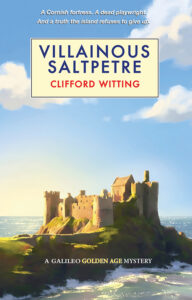 Villanous Saltpetre (1962) is the latest Clifford Witting to be released by the splendid Galileo Publishers.
In 1930, Guy Brangley, an unsuccessful playwright, stages his own disappearance as a publicity stunt.Twenty-five years later he really does disappear. His body is recovered from the sea, three days after he was last seen by anyone. Was this the tragic result of yet another publicity stunt? Or had Brangley been pushed from the battlements of his home, Pengawnen Castle? Well, no prizes for guessing …
Though Witting did have a series detective, Inspector Charlton, he wrote an equal number of standalones, and liked to experiment with the form. The results could be a bit uneven as here. Though this will not rank as one of my favourite Wittings, I still found plenty to enjoy. I especially liked the setting, the little island of Trehennis, off the Cornish coast and the patois of the natives, who through long association and intermarriage with the French, have adopted French words without even realizing that they are French. I enjoyed this exchange when Guy’s cleaner is questioned in court about the contents of his waster-paper baskets.
“‘The basket was full jusqu’ au bord by then. I said–‘
‘Please speak in English, Mrs Glynn.’
She looked puzzled. ‘But I am, sir.’
‘Jusqu’ au bord is not English.’
‘Isn’t it, really?’
‘No, it is French.’
Mrs Glyyn considered this, saying at length:
‘Then so is mutton.’
It took some time for the coroner’s officer to obtain silence. The coroner hid his mouth behind his hand.”
The plot is thickened by the arrival of a film crew on the island and though I enjoyed some of the detail and the characters, I felt Witting had let his research get out of hand so that the story did sag in the middle somewhat, and I kept having to look back to check who was who, before in the end a satisfactory solution emerged.
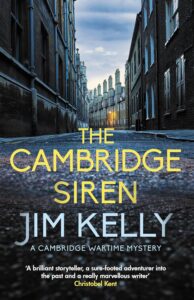 From Cornwall to Cambridge and Jim Kelly’s The American Suspect, the fifth in the splendid Nighthawk series set in Cambridge during WWII. Cambridge has a special place in my heart as it is where I met and married my husband, but I think I’d love this series anyway. This one is set in October 1942, after the US has joined the war and thousands of American GIs are stationed near Cambridge. Detective Inspector Eden Brooke is called to an aerodrome east of the city when the remains of a First World War airman are uncovered by workers extending the runway. The crime may have its roots in the past, but there are repercussion in the present. A second murder leads to the arrest of a black US serviceman, whom Brooke becomes convinced is innocent. Will he uncover the truth in time to save the man from the gallows and find the real culprit? The period detail is spot-on, Brooke and his family are engaging characters, and the plot dovetails nicely. I’m already looking forward to the next one.
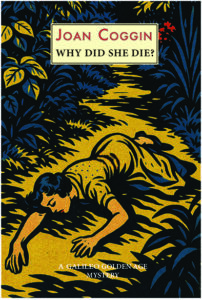 There are many monstrous mothers and tyrannical fathers in GA crime fiction, but in Joan Coggin’s Why Did She Die (1947), it is a sister whose passive-aggressive behaviour and skill at manipulating others leaves no shortage of suspects when she is found dead in the garden with a gunshot wound to the head. I enjoyed the gradual reveal of just what an appalling person Penelope is. The amateur sleuth, Lady Lupin, with her breathless dithering, might not be everyone’s cup of tea, but I like her. She is not much of a housekeeper, but she does rather well as a vicar’s wife and when a woman goes into labour she and the parlourmaid save the day. In those days a middle-class family could still have a parlour maid! Another offering from the estimable Galileo Publishers. All in all, a fun read.
.
4 Comments
Moira@Clothes in Books
August 14, 2026Ooh three very tempting titles there!
I do enjoy Clifford Witting, even though – as you imply – perhaps he could have done with a hard-headed editor.
I wasn’t aware of the Jim Kelly series. I read a book by him many years ago (I think – I assume it’s the same Jim Kelly) and I love the sound of this setup.
Lady Lupin leaves me a bit stony-faced, but the book sounds good…
Christine Poulson
August 14, 2026I do think you’d enjoy the Jim Kelly series – I know you like a home front novel and these are very good on that time and place. Yes, in two minds about Lady Lupin, but she isn’t quite as gormless here as she is in the other novels. Witting is never less than readable and he can be very funny.
di
August 27, 2026So glad to read this Jim Kelly review! I have been hovering around him, will jump right in now. Thanks!
Christine Poulson
August 28, 2026I hope you’ll enjoy him! I am especially pleased to hear from you because I tried to comment on your last post and your blog wasn’t having it! I don’t know why.